

V-type vs. D-type Rubber Fenders: Which is Better
Rubber fenders play a key role in marine safety. They are fitted to docks, piers, wharves, terminals, and other waterfront structures. When a ship comes in to dock, these fenders take the hit and help manage the impact energy. That reduction in force helps limit harm to both the vessel and the port structure.
Two designs show up often in marine use: V-type and D-type rubber fenders. They are popular because of their durable construction, reliable energy absorption, and versatility across different marine environments. However, their structural designs, installation requirements, performance characteristics, and typical applications are different.
If you are a port operator, shipbuilder, marine engineer, or equipment buyer, knowing how the V-type and D-type rubber fenders differ helps you choose the most suitable solution for your projects.
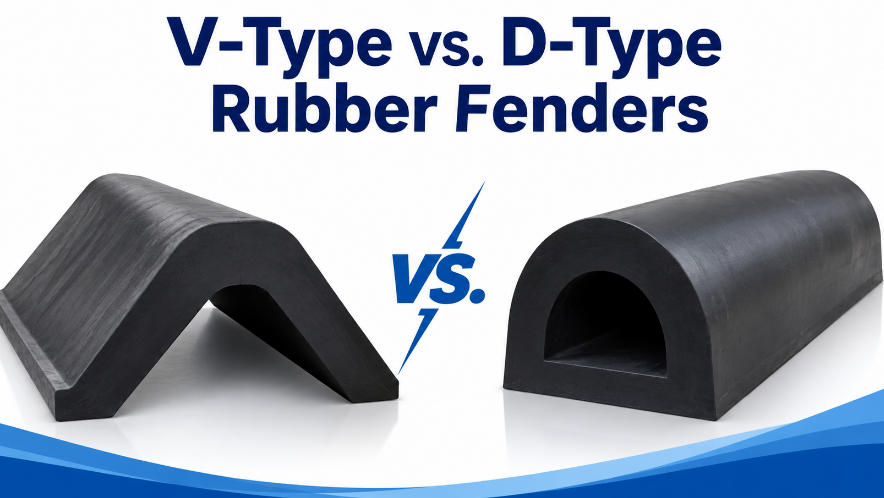
Table of Contents
An Overview of V-type Rubber Fenders
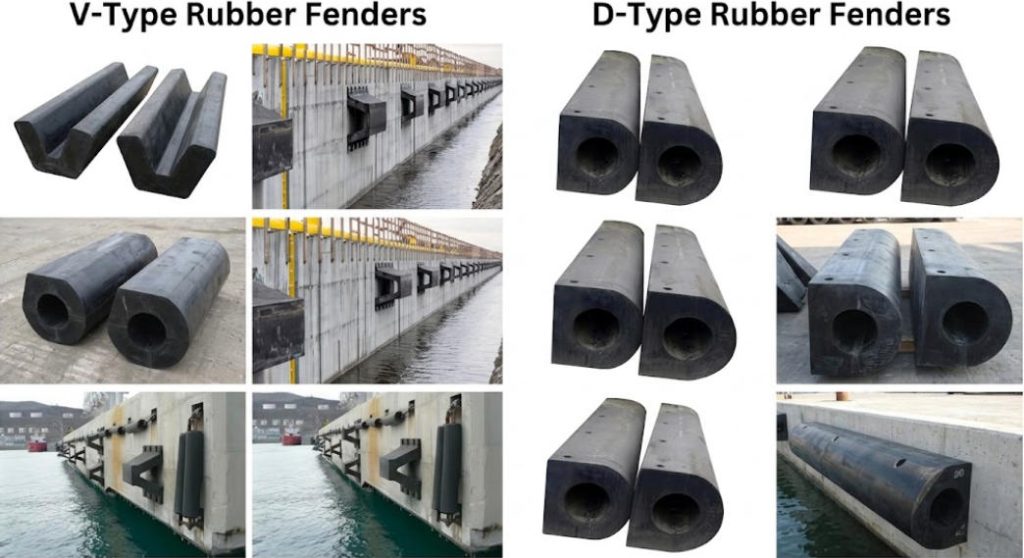
V-type rubber fenders are sometimes listed as arch-type rubber fenders in certain catalogs. Their cross-section is V-shaped, or it looks arched when you view the profile. These units are usually made from natural rubber or synthetic rubber mixes. Common production methods include molding and extrusion.
When a vessel touches the fender, the rubber body deforms. This change in shape spreads out the impact and lowers the reaction force. Less force then reaches the dock or the vessel hull.
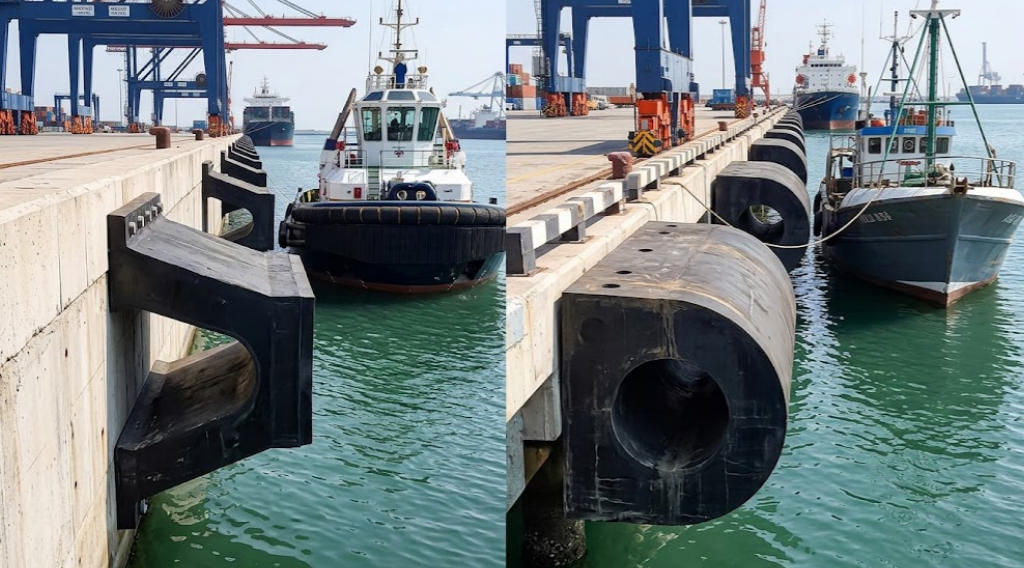
You often see V-type fenders on concrete quay walls and at port terminals. They are also used on offshore platforms and other sites that need steady impact protection.
A common benefit is that they can take in a lot of energy for the size of the unit. They also handle repeated compression during regular berthing. For many projects, they come in different lengths, dimensions, rubber compounds, and mounting options.

An Overview of D-type Rubber Fenders
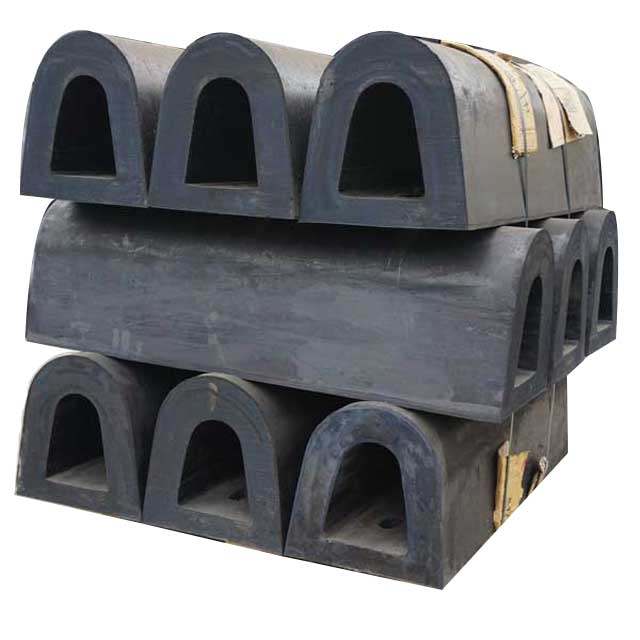
D-type rubber fenders are made with a D-shaped cross-section. One side is flat for mounting. The other side is rounded where the vessel makes contact.
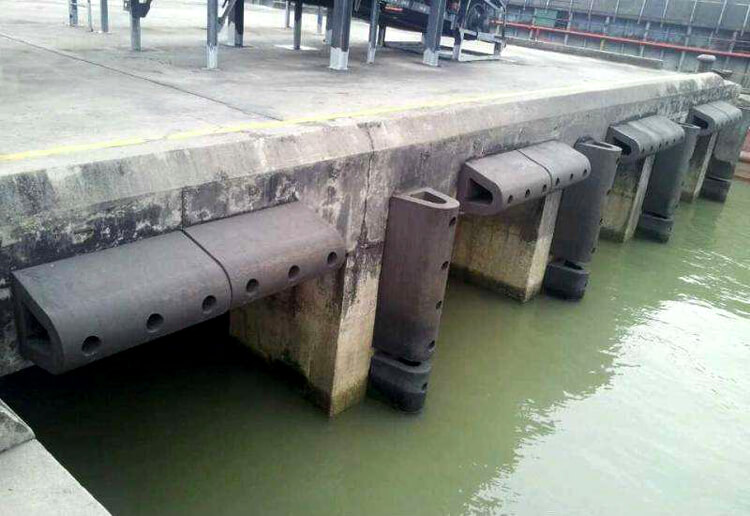
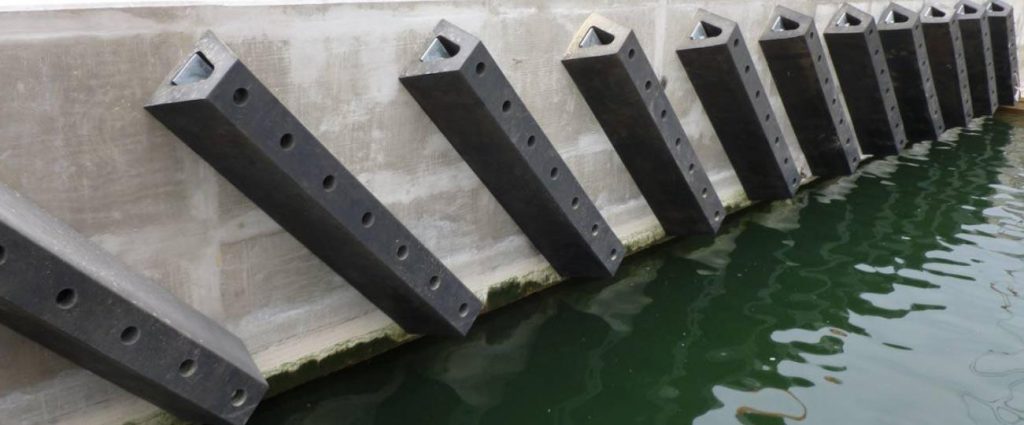
These fenders are typically built from tough rubber meant for impact, abrasion, weather exposure, and repeated compression. The flat back helps with mounting on flat faces. That makes installation simpler on small docks, piers, quay walls, and on the sides of vessels.
The rounded front gives a softer contact area. This helps reduce hard, direct rubbing between the ship and the marine structure. D-type fenders come in many sizes and lengths to suit different vessel types and site conditions. In some cases, they can be set up with mounting holes, steel inserts, or other fitting parts used for that job.
Due to their straightforward structure, convenient installation, and relatively low maintenance requirements, D-type rubber fenders are widely used in small and medium-sized marine facilities.
Key Differences Between V-type and D-type Rubber Fenders
1. Structural Design and Shape
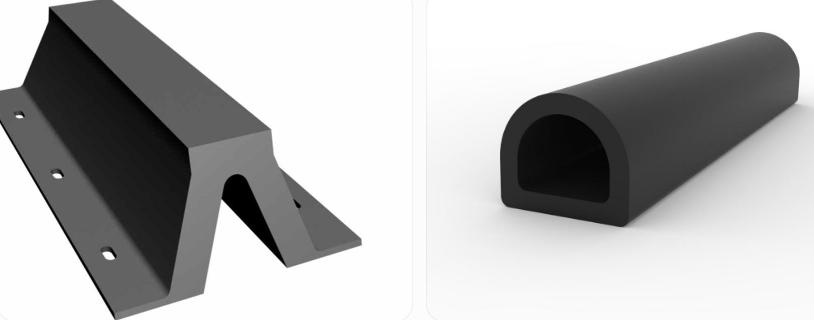
The most obvious difference between V-type and D-type rubber fenders is their cross-sectional shape.
V-type fenders have an arched or V-like body. When a ship presses into them, the rubber can bend and change shape. This helps move the hit load through the fender and offers padding when the vessel pulls in.
D-type fenders use a D-shaped cross-section. The back is flat, and the front is rounded. The flat side helps with mounting on docks, quay walls, and the vessel contact area. The rounded part meets the ship in a safer, protective way.
Because of these forms, they bend in different ways, take in impact energy differently, and sit against marine structures in their own way.
2. Energy Absorption Capacity
Energy absorption matters a lot for marine rubber fenders. It means how much impact energy the fender can take during berthing.
V-type fenders are made to soak up energy through the flexible arched body. Their way of deforming suits setups that need solid energy absorption without using too much space.
D-type fenders are often used where protection needs are not extreme. Small and medium facilities fit this use case well. Their energy absorption depends on size, rubber hardness, material makeup, and how much compression they are built to handle.
| Comparison Factor | V-Type Rubber Fenders | D-Type Rubber Fenders |
| Structural deformation | Arch-shaped compression | Compression of rounded rubber section |
| Energy absorption | Often suitable for higher-energy applications | Generally suited to moderate-energy applications |
| Compression behavior | Flexible deformation of the arch structure | Compression and deformation of the rounded profile |
| Performance factors | Profile dimensions, rubber compound, compression | Fender diameter, rubber hardness, compression |
| Typical applications | Commercial ports and larger berthing facilities | Small docks, marinas, and workboats |
It is important to compare actual manufacturer performance curves rather than assume that every V-type fender absorbs more energy than every D-type model.
3. Reaction Force Performance
Reaction force is the force a compressed fender pushes back toward the ship and the dock.
A good match for a project should handle the needed berthing energy. At the same time, it should keep the reaction force in a range that will not cause trouble. This is extra important for ships with fragile hull parts and for docks that cannot take high loads.
With the right size and rubber settings, V-type fenders can give a decent mix of energy absorption and reaction force.
D-type fenders cushion using the rounded contact area. The reaction force changes with the rubber blend, the cross-section, and how much the fender is compressed.
| Performance Aspect | V-Type Rubber Fenders | D-Type Rubber Fenders |
| Reaction force characteristics | Determined by arch geometry and rubber properties | Determined by rounded profile and rubber properties |
| Load distribution | Through the deformable arch structure | Through the contact area and mounting base |
| Impact protection | Suitable for engineered, demanding berthing conditions | Suitable for general docking and side protection |
| Design consideration | Balance energy absorption and structural loading | Avoid excessive compression and localized loading |
For projects involving large vessels, engineers should calculate berthing energy and evaluate reaction force before determining the appropriate fender configuration.
4. Installation Methods
Installation requirements are another important distinction between these two fender types.
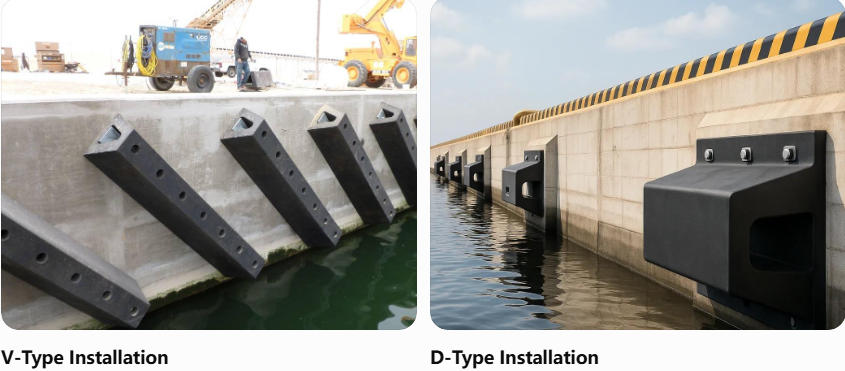
V-type rubber fenders usually need a proper setup to keep their designed compression behavior. Some versions call for anchor bolts, mounting plates, and other fixing parts. You also need to align everything well so performance stays steady.
D-type rubber fenders are often simpler to fit since the mounting face is flat. They can be fastened to flat concrete or steel using the right bolts and other fixing parts.
| Installation Factor | V-Type Rubber Fenders | D-Type Rubber Fenders |
| Mounting structure | Depends on the specific fender design | Usually a flat mounting surface |
| Fixing accessories | Anchor bolts, plates, or designed brackets | Bolts, washers, and mounting accessories |
| Alignment requirements | Important for intended deformation | Important for stable contact and fastening |
| Installation complexity | May require more detailed positioning | Generally straightforward |
| Maintenance access | Depends on installation configuration | Generally convenient |
Regardless of the selected type, rubber fender installation should follow approved engineering drawings and the manufacturer’s recommendations.
5. Materials and Durability
V-type and D-type rubber fenders are usually made from natural rubber, synthetic rubber, or rubber blends made for marine use.
What material is picked affects how well the fender can stretch, how it handles pressure, how it resists scuffing, how it holds up over time, and how long it lasts.
For V-type rubber fenders, the rubber needs the right balance of stiffness and flexibility. It must keep its shape changes and its energy uptake when impacts happen again and again.
For D-type rubber fenders, the rubber compound must be tough. It should handle frequent rubbing, pressure, wear from contact, and long exposure to harsh sea conditions.
| Material and Durability Factor | V-Type Rubber Fenders | D-Type Rubber Fenders |
| Common materials | Natural and synthetic rubber compounds | Natural and synthetic rubber compounds |
| Elasticity | Important for arch deformation | Important for cushioning performance |
| Abrasion resistance | Needed for repeated vessel contact | Needed for continuous docking contact |
| Aging resistance | Important for outdoor marine installations | Important for long-term marine exposure |
| Environmental resistance | Saltwater, ozone, UV, and temperature changes | Saltwater, ozone, UV, and temperature changes |
| Service life | Depends on material quality and operating conditions | Depends on material quality and operating conditions |
High-quality rubber compounds and appropriate manufacturing processes help improve the durability of both fender designs.
6. Typical Applications
V-type and D-type rubber fenders are used in different marine environments according to their structural characteristics and performance requirements.
| Application | Commonly Selected Type | Main Reason |
| Commercial ports | V-Type | Suitable for engineered berthing protection |
| Cargo terminals | V-Type | Can accommodate demanding impact requirements |
| Industrial wharves | V-Type | Provides robust marine impact protection |
| Offshore facilities | V-Type | Can be designed for specific structural requirements |
| Small marinas | D-Type | Practical for smaller vessels |
| Fishing harbors | D-Type | Convenient for frequent docking operations |
| Tugboats and workboats | D-Type | Suitable for side protection |
| Floating docks | D-Type | Convenient mounting configuration |
These are general application tendencies rather than strict rules. Both types can be customized for different vessel sizes and operating conditions.
7. Maintenance Requirements
Regular maintenance in rubber fenders is necessary to ensure the products continue to provide reliable protection throughout their service life.
V-type rubber fenders should be checked for splits, too much shape change, worn outer surface, and any issues near the mount areas. The full set up should also be checked so the fender stays in the correct place.
D-type rubber fenders should be checked for worn surface, cracking in the rubber, damage from compression, and any loose bolts. Extra focus should go to the fixing zone since a firm hold is important for steady use.
| Maintenance Item | V-Type Rubber Fenders | D-Type Rubber Fenders |
| Surface inspection | Check cracks and deformation | Check cracks and abrasion |
| Mounting inspection | Check bolts and supporting brackets | Check bolts and flat mounting surface |
| Compression condition | Check permanent deformation | Check excessive compression |
| Material aging | Inspect hardening and deterioration | Inspect hardening and deterioration |
| Replacement | Replace damaged or performance-compromised units | Replace damaged or worn units |
A regular inspection schedule based on operating conditions can help prevent unexpected failures and reduce long-term maintenance costs.
Summary Comparison Table of V-Type and D-Type Rubber Fenders
| Comparison Factor | V-Type Rubber Fenders | D-Type Rubber Fenders |
| Cross-Sectional Shape | V-shaped or arched structure | D-shaped structure with a flat back and rounded front |
| Structural Design | Flexible arch-shaped body | Solid rounded rubber profile |
| Energy Absorption | Often suitable for higher-energy applications | Generally suitable for moderate impact protection |
| Reaction Force | Depends on arch geometry, dimensions, and rubber properties | Depends on profile size, rubber hardness, and compression |
| Compression Behavior | Deforms through compression of the arch structure | Deforms through compression of the rounded section |
| Load Distribution | Transfers impact through the arch structure | Transfers impact through the rounded contact surface and mounting base |
| Installation Method | May require dedicated mounting arrangements and anchor bolts | Usually installed using bolts through or along the flat mounting base |
| Installation Complexity | May require careful alignment and positioning | Generally straightforward to install |
| Space Requirements | Suitable for compact, engineered protection systems | Suitable for installations requiring a simple mounting profile |
| Material Options | Natural rubber and synthetic rubber compounds | Natural rubber and synthetic rubber compounds |
| Durability | Designed to withstand repeated compression and marine exposure | Designed to resist abrasion, compression, and marine exposure |
| Maintenance | Inspect deformation, cracks, and mounting components | Inspect surface wear, cracks, and fastening bolts |
| Common Applications | Commercial ports, cargo terminals, industrial wharves, offshore facilities | Small docks, fishing harbors, marinas, tugboats, and workboats |
| Main Advantages | Effective energy absorption potential and compact design | Simple structure, convenient installation, and versatile applications |
| Potential Limitations | Mounting arrangements may be more demanding | Standard configurations may not meet high-energy berthing requirements |
| Selection Considerations | Berthing energy, reaction force, compression, and mounting design | Vessel size, impact conditions, mounting space, and required protection |
How to Choose Between V-type and D-type Rubber Fenders
Choosing between V-type and D-type rubber fenders requires more than comparing their shapes and dimensions. Several technical and operational factors should be evaluated before purchasing.
1. Vessel Size and Weight
Vessel size and weight, plus the vessel type, affect the berthing energy the fender system must take in. Bigger ships usually call for a more planned fender setup with enough energy capacity.
2. Berthing Velocity
How fast the vessel comes in is also a key factor. Even a slight rise in approach speed can raise the impact energy a lot. So the fender choice should match the expected berthing conditions, not just the vessel size.
3. Installation Space
The space for installation limits the fender size and its profile. V-type fenders can work well in some tight, fast work setups. D-type fenders often fit well on many flat surfaces because the mounting can be direct.
4. Environmental Conditions
Marine environments expose rubber fenders to saltwater, ultraviolet radiation, temperature fluctuations, and mechanical wear. Buyers should select suitable rubber compounds with good resistance to aging, ozone, abrasion, and environmental exposure.
5. Installation and Maintenance Costs
The purchase price is only part of the total cost. Mounting items, installer work, inspection needs, how often parts must be replaced, and ongoing upkeep costs should also be planned for.
6. Manufacturer Quality and Customization
Choosing a skilled rubber fender manufacturer can help match the product to the needs of the job. Buyers should look closely at the rubber quality, the exact size of the parts, how the items are made, what tests were done, and what custom options are offered.
7. Installation and Maintenance Considerations
Proper installation and regular maintenance matter for the long service life of both V-type and D-type rubber fenders.
Before work starts, check the mounting area. Confirm it is strong enough, reasonably flat, and free of dirt or residue. Also confirm the fender size and the bolt or fixing points match the approved drawings.
V-type rubber fenders need careful fitting. Make sure the alignment is correct and the compression direction is right. Also confirm the fastening setup follows the plan. If it is installed incorrectly, the fender may not deform as expected, and its energy absorption may drop.
D-type rubber fenders should sit on a flat surface with solid contact. Secure the base well so it stays stable against the support. Use mounting bolts and related parts that follow the manufacturer’s guidance.
Keep an eye on the condition over time. During checks, watch for cracks, too much deformation, worn or damaged surfaces, loose fasteners, and signs of aging. If any part is damaged, assess it and swap it out when needed.
In rough marine conditions, cleaning and inspection on a schedule can help catch issues early, before they harm the full fender setup.
Quick Selection Guide
| Project Requirements | Recommended Option |
| Higher-energy berthing protection | V-Type |
| Commercial port and cargo terminal protection | V-Type |
| Compact engineered fender installation | V-Type |
| Simple and convenient mounting | D-Type |
| Small marina and fishing dock protection | D-Type |
| Tugboat and workboat side protection | D-Type |
| Customized marine impact protection | Either type, subject to engineering calculations |
Summary
- V-type rubber fenders are often suitable for commercial ports, industrial wharves, and other facilities requiring engineered impact protection and effective energy absorption.
- D-type rubber fenders are widely used for small docks, fishing harbors, marinas, tugboats, and workboats because of their simple design, convenient installation, and versatile protection capabilities.
Final Thoughts
V-type and D-type rubber fenders have different structural designs, performance characteristics, installation requirements, and application advantages.
The best selection depends on the berthing energy, the allowed reaction force, vessel features, site installation limits, and exposure to the environment. When buyers compare these factors and work with a trusted marine rubber fender manufacturer, they can choose a dependable option that supports vessel safety and helps protect marine structures for the long term.