
T-Head vs. Horn Mooring Bollards: How to Select the Right Solution
Mooring bollards play a key role in marine work. They keep ships fixed at harbors, port yards, and offshore sites. These marine bollards are designed to handle the pull and shock from mooring lines. Forces come from ship motion, wind, waves, and moving water. Two common options are T-Head mooring bollards and Horn mooring bollards. They differ in structure and in how they guide ropes. That is why engineers, port operators, and shipbuilders often compare them before a site is chosen.
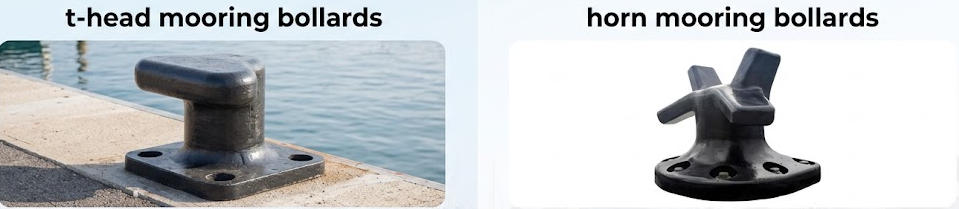
Table of Contents
Overview of T-Head Mooring Bollards
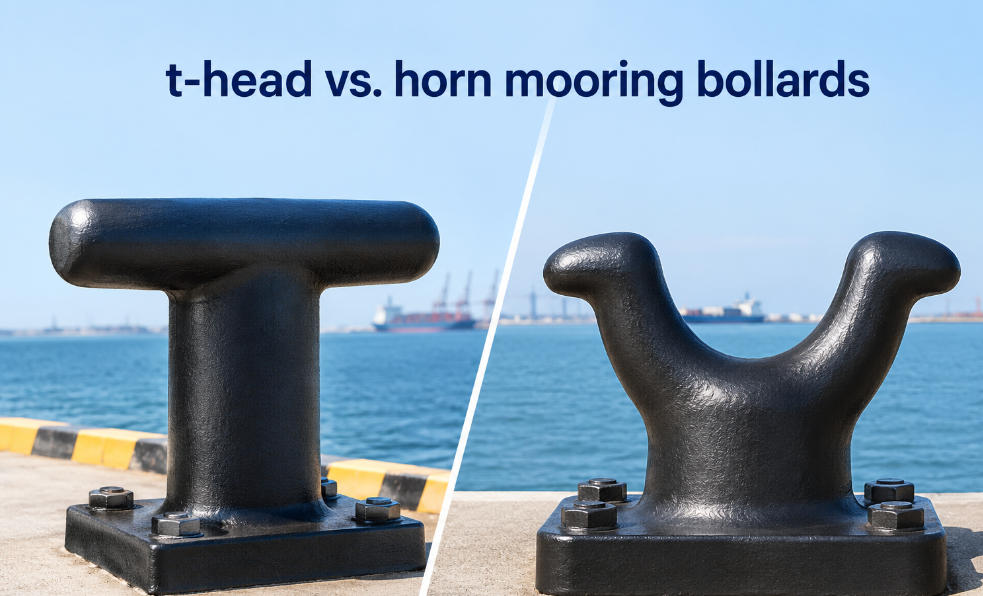
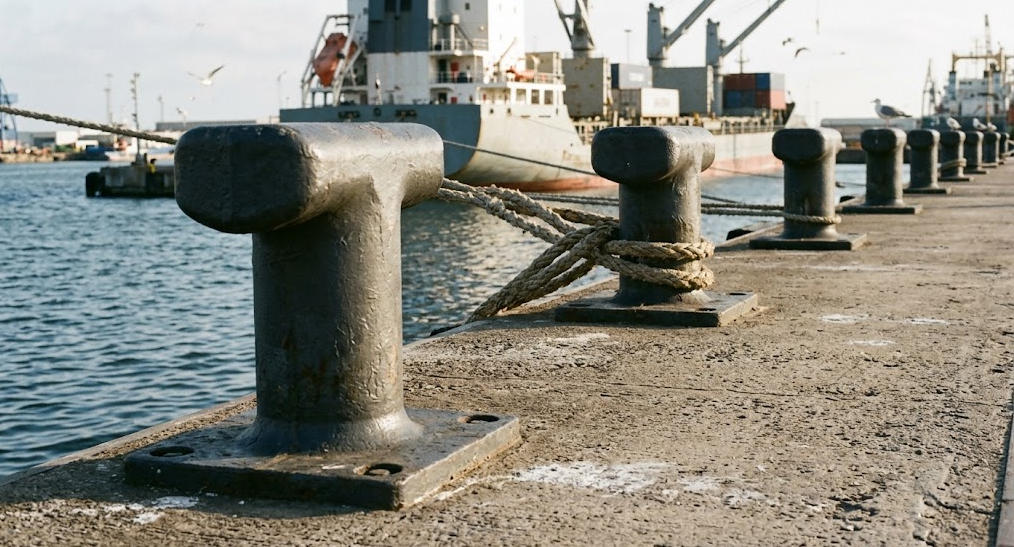
A T-Head mooring bollard has a T-shaped form. There is a main vertical section. At the top, a horizontal head sticks out. This cross head gives a wider area for ropes. It also helps spread the load.
Because the design is straightforward, T-Head bollards show up in many places. You will find them in commercial ports, cargo areas, ferry berths, and ship repair yards. They work well when ships may dock in different spots and the rope setup needs to change.
Main traits of T-Head mooring bollards include:
- Simple T-shaped body
- Rope can be tied on and taken off with ease
- More options for how lines are arranged
- Steady results for general marine use
- Different ratings for load capacity
Overview of Horn Mooring Bollards
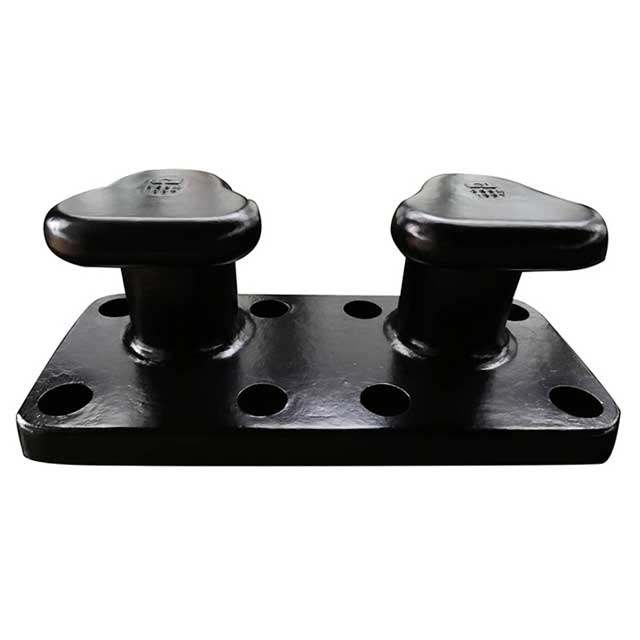
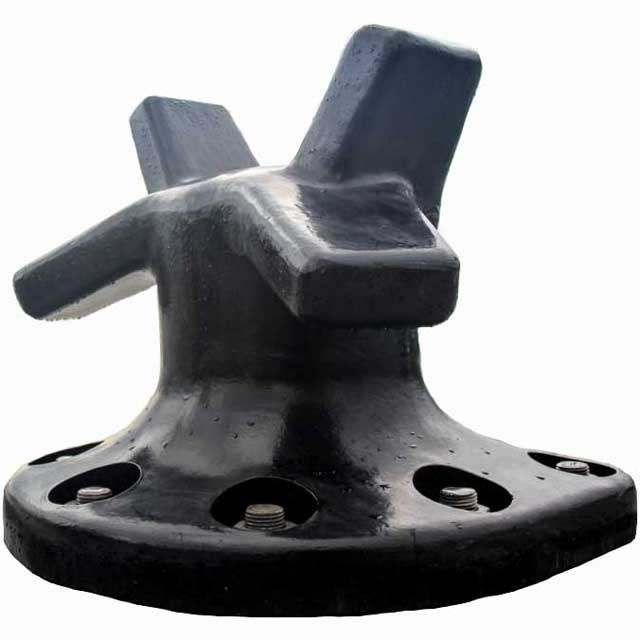
Horn mooring bollards use a different profile. The body has two curved extensions. These rise up like horns. The curved arms can hold the rope better and help keep it in place. That lowers the chance that the rope shifts during ship movement.
Horn bollards are often picked for tougher conditions. When vessels see higher mooring forces, or when the weather changes often, they can be a better match. They are common in big ports, offshore sites, and specialized terminals.
Main traits of Horn mooring bollards include:
- Curved horn-like shape
- Better grip on mooring rope
- Good behavior when loads change fast
- Good fit for bigger ships and hard conditions
- More overall mooring steadiness
Key Differences Between T-Head and Horn Mooring Bollards
1. Structural Differences
The primary difference between the two bollard types is their structural design.
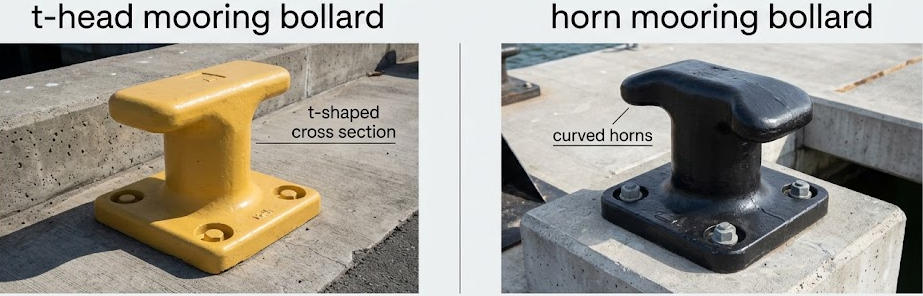
A T-Head bollard has a crosshead. Ropes can be placed around the bollard from more than one angle. The open form also makes line changes easier for the crew.
A Horn bollard has curved arms. These arms act like natural locking points for rope. With this setup, rope movement is easier to control. It can help when ships get pushed by waves or strong wind.
| Feature | T-Head Mooring Bollard | Horn Mooring Bollard |
| Shape | T-shaped with a horizontal top bar | Two curved horn-like arms |
| Rope Support | Supports ropes through the crosshead | Holds ropes securely between horns |
| Design Focus | Flexibility and easy operation | Stability and rope retention |
2. Rope Handling Performance
Rope management matters a lot when choosing a bollard.
T-Head bollards create a wider space to set rope. This helps crew place lines faster. It also makes it easier to hook on, let go, and fine-tune the mooring lines. That is useful in ports that handle many arrivals and departures each day.
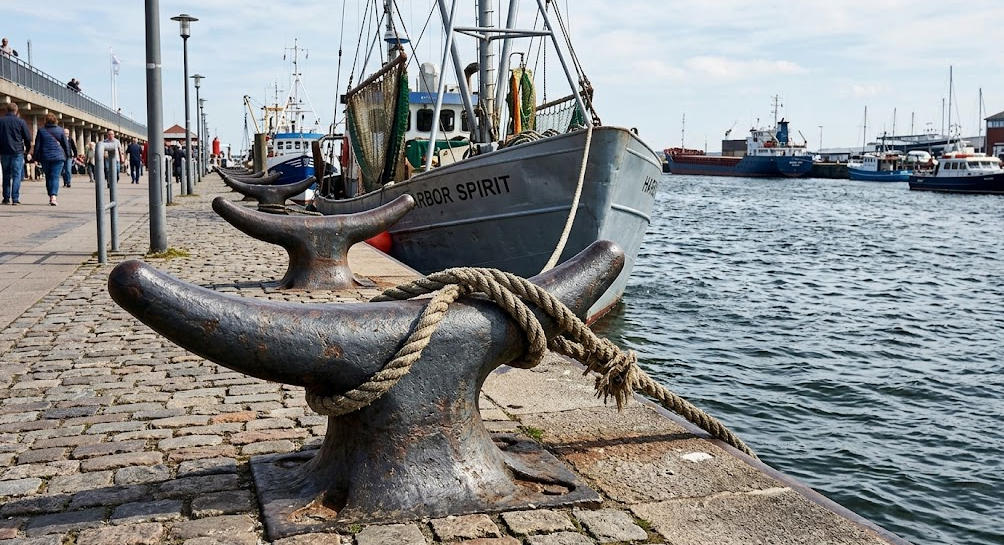
Horn bollards help keep rope in place better. The curved horns guide the line so it is less likely to slide off. This matters more when a vessel sits in rougher water, with strong currents, bigger waves, or shifting weather.
For routine docking work, T-Head bollards are handy and simple to use. In rough or tight marine settings, Horn bollards can add more holding force.
3. Load Capacity and Stability
T-Head and Horn bollards come in multiple sizes and load ratings. Project needs decide what to pick. Still, the shape of each type changes how it handles mooring force.
T-Head bollards spread force through the wide crosshead. Because of that, they fit many commercial vessels. Examples include cargo ships, ferries, and service vessels.
Horn bollards aim to keep the rope lined up when loads rise. The body shape helps deal with shifting forces from vessel motion. This is why this type of mooring bollard is used for larger ships and berths with higher load demands.
4. Maintenance and Installation
T-Head bollards usually have a simpler form. That can make installation and upkeep less involved. With fewer parts, teams can inspect and clean them more easily.
Horn bollards call for extra attention during checks. The curved parts and the shape add inspection points. Even so, that design supports better rope security and dependable operation in harsher conditions.
For both types, a solid foundation matters. Corrosion protection is also key. Regular checks help keep service life on track.
Summary Comparison Table of T-Head and Horn Mooring Bollards
| Comparison Factor | T-Head Mooring Bollards | Horn Mooring Bollards |
| Design Structure | Features a vertical body with a horizontal crosshead on top, forming a “T” shape | Features two curved arms extending upward, creating a horn-like structure |
| Main Function | Provides a secure point for attaching and arranging mooring ropes | Provides secure rope retention and prevents lines from slipping |
| Rope Handling | Allows flexible rope placement and easy adjustment of mooring lines | Guides ropes into fixed positions for improved stability |
| Rope Security | Offers reliable rope support under normal mooring conditions | Provides stronger rope holding capability under dynamic conditions |
| Load Distribution | Distributes mooring forces through the wide horizontal head | Transfers loads through the curved horn structure |
| Operational Flexibility | Suitable for different mooring arrangements and vessel types | Designed for more controlled and stable mooring operations |
| Vessel Compatibility | Commonly used for small to medium vessels and general cargo ships | Often selected for large vessels requiring higher mooring stability |
| Environmental Performance | Performs well in standard port and harbor conditions | Better suited for areas affected by strong winds, waves, and currents |
| Installation Space | Requires more horizontal space due to the extended crosshead | Usually requires less horizontal space with its vertical horn design |
| Maintenance | Simple structure allows easier mooring bollard maintenance practices | Curved structure may require more detailed inspection |
| Manufacturing Complexity | Relatively simple design and manufacturing process | More complex design due to curved horn components |
| Typical Applications | Commercial docks, container terminals, ferry terminals, and shipyards | Bulk terminals, offshore facilities, oil & gas terminals, and heavy-duty berths |
| Advantages | Flexible operation, easy rope handling, cost-effective, widely applicable | Excellent rope retention, high stability, suitable for demanding conditions |
| Limitations | May provide less rope control in highly dynamic environments | Higher complexity and may require more specialized installation |
| Best Choice For | Ports needing versatile and general-purpose mooring solutions | Facilities requiring maximum rope security and heavy-load performance |
Key Factors to Consider for Choosing Between T-Head and Horn Mooring Bollards
When engineers and port operators compare Tee-Head and Horn mooring bollards, they should review vessel needs, mooring loads, local weather and water, and available installation space.
1. Vessel Size and Type
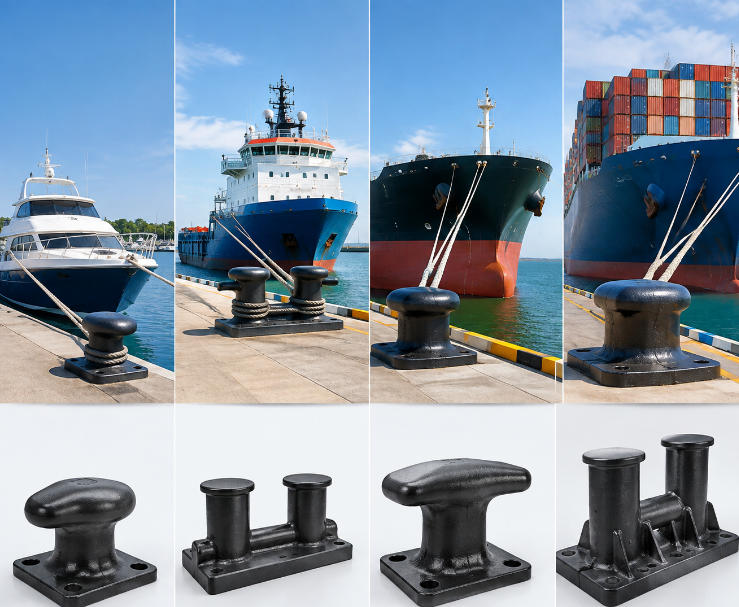
Vessel size and vessel type are key for choosing a mooring bollard. Big ships usually create bigger mooring forces. They need bollards with enough load rating and dependable rope control.
T-Head mooring bollards are used often for general cargo ships, ferries, container vessels, and similar commercial craft. They allow flexible rope setups and steady handling.
Horn mooring bollards are chosen more for larger vessels and special marine work. Stable rope placement is important there. The horn form helps hold the mooring lines more firmly when a ship moves.
2. Mooring Load Requirements
Expected mooring load drives the bollard choice and rating. Mooring forces change with vessel displacement, wind pressure, wave impacts, currents, and day to day operating conditions.
T-Head bollards work well in many typical port setups. They spread the forces through the horizontal crosshead, which helps them stay dependable.
Horn bollards fit tougher conditions. Their shape supports rope positioning when loads shift. If a terminal serves very large vessels or faces rough exposure, keeping the rope in place can matter a lot.
3. Environmental Conditions
Marine sites differ from one place to another. Wind, wave action, tides, and currents can add more forces to both the ship and the mooring gear.
In calmer harbors and protected ports, T-Head mooring bollards can be enough. They also tend to be simple to operate and maintain.
Where weather gets severe or water movement is strong, Horn mooring bollards can offer a benefit. They help hold mooring lines more steady while the vessel is moving.
4. Mooring Line Arrangement
How the mooring lines are laid out at the berth affects the bollard choice.
With T-Head bollards, the horizontal face gives room to attach ropes from multiple directions. That is helpful at sites that handle different vessel types. It also helps when mooring plans change.
Horn bollards guide rope placement in a more consistent way. That makes them a good match for berths that need steady line positioning. They are often chosen for fixed mooring setups with heavy daily use.
5. Port and Terminal Application
The kind of facility in the port is worth checking before choosing T-Head or Horn bollards.
T-Head mooring bollards are often installed at:
- General cargo terminals
- Container ports
- Ferry terminals
- Shipyards
- Commercial docks
This flexible design suits many kinds of vessel work.
Horn mooring bollards are commonly used at:
- Bulk cargo terminals
- Oil and gas facilities
- Offshore support bases
- Large vessel berths
- Heavy-duty industrial ports
These applications often need stronger rope control. They also want better operational steadiness.
6. Installation Space and Layout
The room available for mooring bollard installation can drive which bollard design fits.
Port plans vary. They depend on berth size, quay layout, and how ships are expected to sit.
Tee-Head bollards need enough horizontal space for the extended crosshead. This extra reach helps with rope handling options.
Horn bollards are usually more compact in height. That can help where horizontal space is tight. It can also fit cases where the mooring layout should stay more controlled.
7. Safety Requirements
Safety should be treated as a main factor in any mooring setup. A good bollard should reduce issues like rope slipping, overloading, and sudden ship movement.
Tee-Head bollards work well in many common setups. They suit cases where you need smooth and flexible use.
Horn bollards can add extra safety when loads are high. They help keep mooring lines in the right place as conditions shift.
Summary
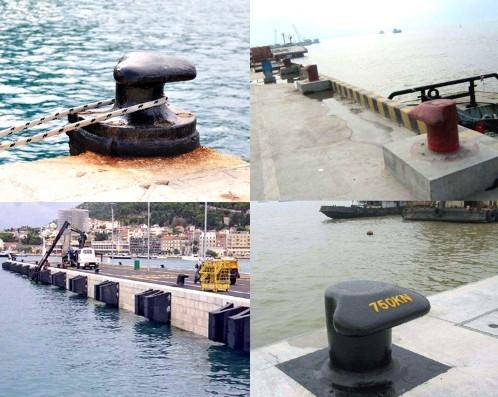
- T-head bollards are known for their versatility, simple structure, and flexible rope handling, making them suitable for many general marine applications.
- Horn bollards provide enhanced rope retention and are often selected for heavy-duty operations where stability and secure line control are priorities.
Final Thoughts
T-head and Horn mooring bollards both help secure vessels. However, each one is designed for different work. When selecting a mooring bollard, factors such as vessel size, mooring forces, dock design, and environmental conditions should be carefully evaluated. Choosing the right type supports safer handling, steadier efficiency, and better long-term use at marine sites.