
What are the Wear Monitoring Technologies for Anchor Chains
Anchor chains are constantly hit by mechanical stress, corrosion, friction, and impact forces, so wear and degradation are basically unavoidable over time. If an anchor chain fails in a sudden moment, it can cause serious outcomes like vessel drift, stoppages during offshore work, environmental harm, and large monetary losses. For that reason, effective wear monitoring technologies for anchor chains are really matter for assessing condition, estimating maintenance timing, and strengthening operational safety.
Table of Contents
Understanding the Roles of Anchor Chains
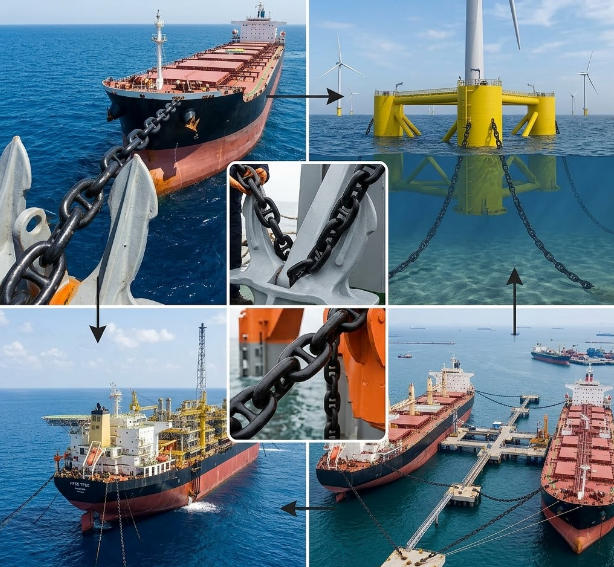
Anchor chains are key elements in offshore mooring systems, ship anchoring systems and marine structures. They help hold the position of vessels, floating platforms, and offshore installations when the environment is harsh, for example, strong currents, ocean waves, wind pressure, plus seabed interaction.
Advantages of Using Wear Monitoring Technologies for Anchor Chains
1. Improving Operational Safety
Wear monitoring technologies help spot early symptoms of anchor chain deterioration, including corrosion, cracks, fatigue damage, and extra material loss. By catching potential problems before they become critical, these systems reduce the chance of sudden chain failure and improve safety for vessels, offshore platforms, and other marine structures working in harsh environments.
2. Extending Anchor Chain Service Life
Continuous monitoring gives detailed information about the actual state of anchor chains. Once operators understand wear patterns, plus how damage is developing, they can take preventive actions to limit further deterioration. This helps maximize the usable service life of anchor chains and also cuts down the need for replacement that happens too soon.
3. Reducing Maintenance Costs
Advanced monitoring technologies help shift maintenance strategies toward condition-based and predictive approaches, rather than depending only on fixed inspection schedules. Operators can take action when it is truly needed. This avoids unnecessary checkups and it also lowers repair costs linked to sudden failures or serious damage.
4. Enhancing Inspection Accuracy
Old school inspection methods can miss concealed defects, or damage that is still at the early stage. Wear monitoring technologies such as ultrasonic testing, magnetic inspection, underwater robotic systems and sensor-based monitoring provide a sharper look at the chain’s condition. in practice this improves the ability to spot defects and it helps teams decide what maintenance to do, before problems grow.
5. Enabling Real-Time Condition Monitoring
Modern monitoring systems, with sensors and digital data platforms, can keep gathering information about anchor chain loads, stress states, corrosion measures, and structural changes, continuously. With real-time monitoring in place, operators can react fast when something looks abnormal, and they can raise overall operational governance.
6. Improving Offshore Asset Management
Wear monitoring technologies deliver useful data for handling offshore mooring systems over the full lifecycle. When inspection findings, environmental context, and past performance records are combined, operators can tune maintenance schedules and support more steady long-term management of essential marine assets.
7. Increasing Cost Efficiency and Reliability
Even though advanced monitoring systems need an upfront investment, they still end up giving long-term economic advantages through lowering failure risks, cutting down downtime, and raising maintenance effectiveness. When anchor chain monitoring is dependable, it supports safer, more economical, and more sustainable sea operations overall.
Common Types of Anchor Chain Wear
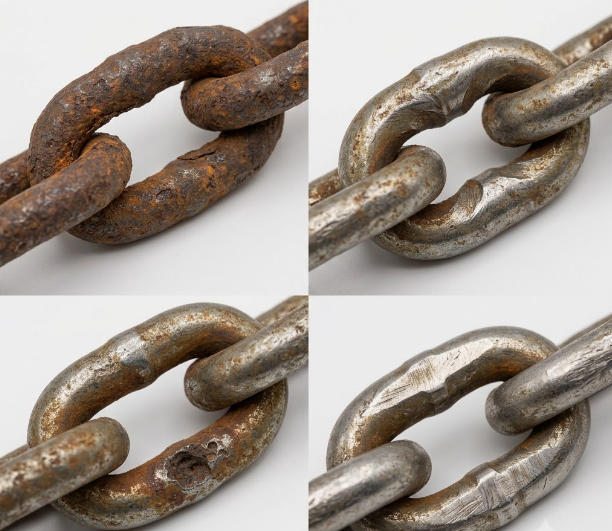
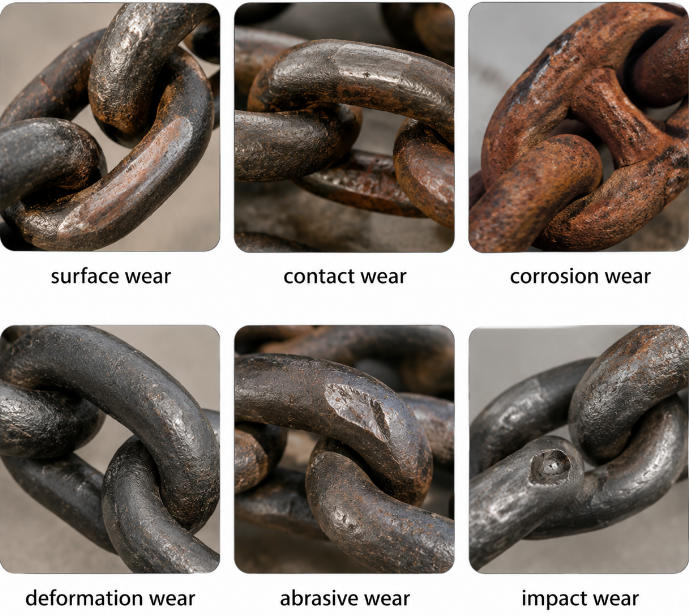
Before using any wear monitoring technologies, it really helps to grasp the main ways an anchor chain gets worn out. In daily long-term service, anchor chains usually go through multiple degradation modes.
| Type of Anchor Chain Wear | Description | Main Causes | Potential Impact |
| Mechanical Wear | Gradual material loss caused by repeated friction and contact between chain links, connectors, and other components. | Continuous movement, link-to-link contact, vibration, and seabed interaction. | Reduction of the diameter of anchor chain link, decreased strength, and increased risk of chain failure. |
| Corrosion Wear | Deterioration of steel material due to chemical reactions with seawater and marine environments. | High salinity, oxygen exposure, marine organisms, and insufficient protective coatings. | Material thinning, surface pitting, cracks, and reduced load-bearing capacity. |
| Fatigue Damage | Progressive damage caused by repeated loading and unloading cycles over the service life of the chain. | Wave-induced motion, vessel movement, cyclic tension changes, and long-term stress concentration. | Formation of fatigue cracks, structural weakening, and possible sudden breakage. |
| Abrasion Wear | Surface damage caused by friction between the chain and external materials such as seabed rocks or marine structures. | Dragging on rough seabeds, anchor movement, and contact with offshore equipment. | Local material loss, surface roughness, and accelerated chain deterioration. |
| Link Deformation | Permanent changes in the shape of chain links caused by excessive forces or abnormal loading conditions. | Overloading, improper mooring arrangements, impact forces, and extreme weather conditions. | Reduced chain flexibility, uneven load distribution, and higher failure probability. |
| Pitting Corrosion | Localized corrosion that creates small holes or cavities on the chain surface. | Chloride ions in seawater, damaged coatings, and localized chemical reactions. | Reduced cross-sectional area, stress concentration, and increased crack formation risk. |
| Crack Formation | Development of surface or internal cracks due to mechanical stress, fatigue, or corrosion effects. | Repeated loading, manufacturing defects, stress concentration points, and environmental exposure. | Serious structural damage and potential sudden chain rupture. |
| Galvanic Wear | Corrosion caused by electrical interaction between different metals in contact with seawater. | Use of dissimilar metals in chain components, connectors, or accessories. | Accelerated corrosion of less noble metals and reduced component lifespan. |
Key Technologies for Monitoring Wear of Anchor Chains
Modern wear monitoring approaches combine traditional inspection methods with advanced sensing technologies, data analysis, and digital monitoring systems. These technologies help operators detect early signs of damage, optimize maintenance schedules, and extend the service life of anchor chains.
1. Ultrasonic Thickness Measurement Technology
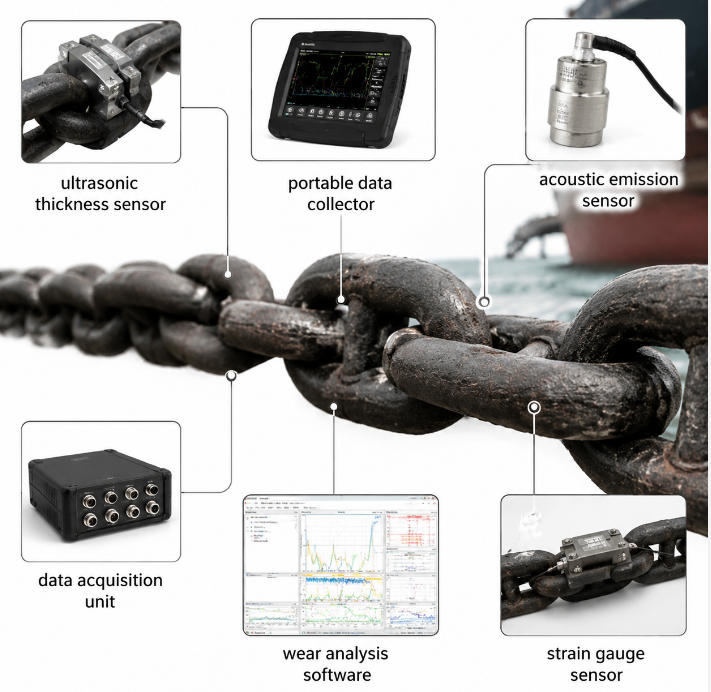
Ultrasonic thickness measurement is one of the frequently used techniques when you need to judge anchor chain wear. It is a non-destructive testing method that relies on high frequency sound waves to read the remaining thickness of the steel chain links and to find material loss tied to corrosion and mechanical abrasion.
During an inspection, ultrasonic sensors send sound waves into the chain material. The returning, reflected signals then get interpreted, so the thickness of the metallic structure can be established. When the measured thickness drops compared with the original specifications, that reduction can point to wear, or corrosion-related damage.
This technology is especially useful because it can reveal hidden decay that might not be seen during a quick visual check, like the surface looks fine but the inside already weakened. It also gives dependable insight into the remaining strength of the chain links and makes it easier for the operators to decide if maintenance has to be done, if a repair is required, or if outright replacement is the wiser route.
2. Magnetic Flux Leakage Inspection Technology
Magnetic flux leakage, often called MFL inspection, is another significant option for tracking wear in anchor chains. Since most anchor chains are made from ferromagnetic steel, magnetic flux methods can highlight variations in the field that happen due to defects or material that is lost.
When a link is magnetized, damaged spots such as cracks, corrosion pits, and small zones of local thinning cause disturbances in the magnetic field. Then sensors can record those differences, and from there they can flag likely trouble areas.
MFL technology turns out to be useful for catching early fatigue issues, and also surface flaws that in time can grow into real structural failure. It gives inspection outcomes fast, and usually gets paired with other testing methods, so you end up with a broader check of anchor chain conditions.
3. Underwater Visual Inspection and Imaging Technology
Underwater visual inspection remains a basic way to follow anchor chain wear over time. In practice divers, remotely operated vehicles (ROVs), and autonomous underwater vehicles (AUVs) with high resolution cameras can look at the chain surface right where it works.
More advanced imaging setups let the operator spot visible deterioration signs, for example corrosion, scuffing, abrasion traces , bending, and even chain parts that look damaged. A number of newer systems also include laser-based measuring tools, and three dimensional imaging functions, those features improve the accuracy of the wear appraisal, sometimes a lot.
Using underwater robots has noticeably improved inspection efficiency, more so for deepwater offshore facilities where the classic diver based inspections are hard to do, expensive, or too risky in practice. And yeah, that shift matters.
4. Laser Measurement and 3D Scanning Technology
Laser measurement and three-dimensional scanning technologies give detailed insight into how the anchor chain geometry changes because of wear. In these systems, laser sensors capture the shape, the actual size, and the surface condition of chain links, so you end up with precise digital models that can be reviewed later.
Then by matching today’s measurements with the original design data, the team can estimate the real wear extent and point to regions where chain dimensions have moved a lot. It helps measurement accuracy and also leaves behind permanent digital records, useful for later condition checks.
3D scanning is especially valuable when tracking long-term wear trends and when backing up predictive maintenance programs.
5. Load and Tension Monitoring Technology
Anchor chain wear is really connected with the forces that show up during use. Constant variations in tension, from waves, wind, currents, and even vessel motion, can speed up fatigue and some mechanical deterioration. So, watching the chain loads gives really useful hints for judging wear risks, early.
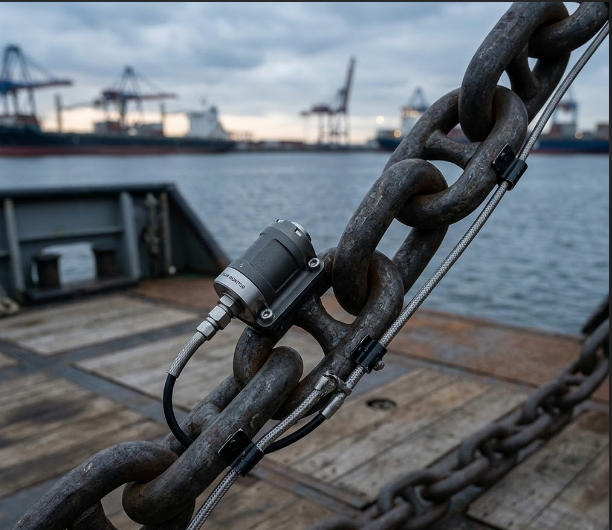
There are load and tension monitoring systems that lean on sensors, like strain gauges, load cells, and wireless monitoring units to capture the forces acting on anchor chains. This gathered information allows operators to see the stress pattern more clearly and also notice abnormal loading situations that might otherwise stay hidden.
Then, if you look at how tension changes across time, you can spot operating states that likely drive accelerated wear, and you can plan preventive actions before serious damage turns up.
6. Fiber Optic Sensing Technology
Fiber optic sensing technology is a advanced solution for continuous monitoring of the anchor chain conditions , it uses transmitted light signal changes to measure physical parameters such as strain, vibration, and temperature, kind of in a direct way though. These sensors turn the light variations into useful readings so engineers can follow what is happening without too much gap in time.
In marine applications fiber optic sensors feel especially durable, they resist electromagnetic interference and they can work in harsh environments, even where people would prefer less sensitive equipment. They also give ongoing insight into structural behavior and can flag changes that appear because of excessive loading or fatigue, before it becomes a bigger concern.
Because the system can collect real-time data, fiber optic monitoring becomes an effective method for raising reliability and safety in offshore mooring systems, with steady oversight rather than occasional checks.
7. Acoustic Emission Monitoring Technology
Acoustic emission monitoring detects sound waves produced when materials experience stress, deformation, or crack growth. Sensors that are installed on anchor chain systems can capture these signals and then analyze structural changes while they are occurring, as if you are listening to the material in motion.
This technology can be handy for spotting active damage processes, such as fatigue crack growth and general structural instability. Compared with older inspection approaches that mostly tell you what is happening only at set inspection times, acoustic emission monitoring can, in a continuous way, follow how the chain condition is changing over time, almost like it keeps talking while things evolve.
For those critical offshore settings, this ability lets operators flag possible failures much earlier and then refine maintenance choices, before the situation escalates.
3. Artificial Intelligence and Machine Learning Technology
Artificial intelligence (AI) and machine learning technologies are changing how anchor chain wear data gets interpreted. Traditional style inspection routines often depend on human interpretation, while AI driven setups can automatically handle big amounts of inspection images, sensor signals and past records, all together.
Machine learning tools are able to detect tendencies linked with wear progression, corrosion growth, and fatigue deterioration. When they look at both past data and live measurements, AI systems can foresee likely chain condition changes and figure out the remaining service life estimate.
That forecasting ability lets operators shift from reactive maintenance routines toward more proactive strategies, which in turn cuts downtime and supports better safety.
4. Digital Twin Technology for Wear Assessment
Digital twin technology gives a virtual representation of an anchor chain system, by pulling together real-time monitoring data and engineering models and operational details. With this, operators can run through simulations of chain performance when the surroundings change, or when different load levels show up, you know.
A digital twin can be used to look at wear growth, anticipate possible failure scenarios, and tune the timing of maintenance work. As the virtual model keeps getting refreshed with fresh inspection data, the team gets a more exact sense of what the chain is doing right now.
Digital twins are becoming a key development path for intelligent marine asset management.
10. Integrated Monitoring Systems
There is no single monitoring method that can deliver the whole picture of anchor chain wear. That is why many modern monitoring solutions merge several technologies, so they can reach a broader and more complete evaluation.
An integrated system may combine ultrasonic inspection, magnetic testing, underwater imaging, load monitoring, fiber optic sensing, and AI analysis-based in a practical way. By analyzing data from multiple sources, operators can get a clearer picture of chain condition and make more reliable maintenance decisions.
Integrated monitoring systems can improve inspection accuracy, strengthen safety management, and help with efficient life-cycle stewardship of anchor chains.
Wear Monitoring for Anchor Chain
Summary
Wear monitoring technologies are essential for keeping the safety and reliability of anchor chains. Traditional visual checks remain useful, but advanced options like ultrasonic testing, magnetic inspection, underwater robotics, fiber optic sensing, acoustic emission monitoring, and artificial intelligence give more accurate and efficient solutions.
As offshore work moves into deeper waters, and marine structures get more complex, continuous and intelligent wear monitoring of anchor chains will become more and more important. If operators use advanced wear detection technologies, they can spot early signs of trouble, cut down on those unexpected stop events, and also expand the working lifespan of key marine mooring systems.